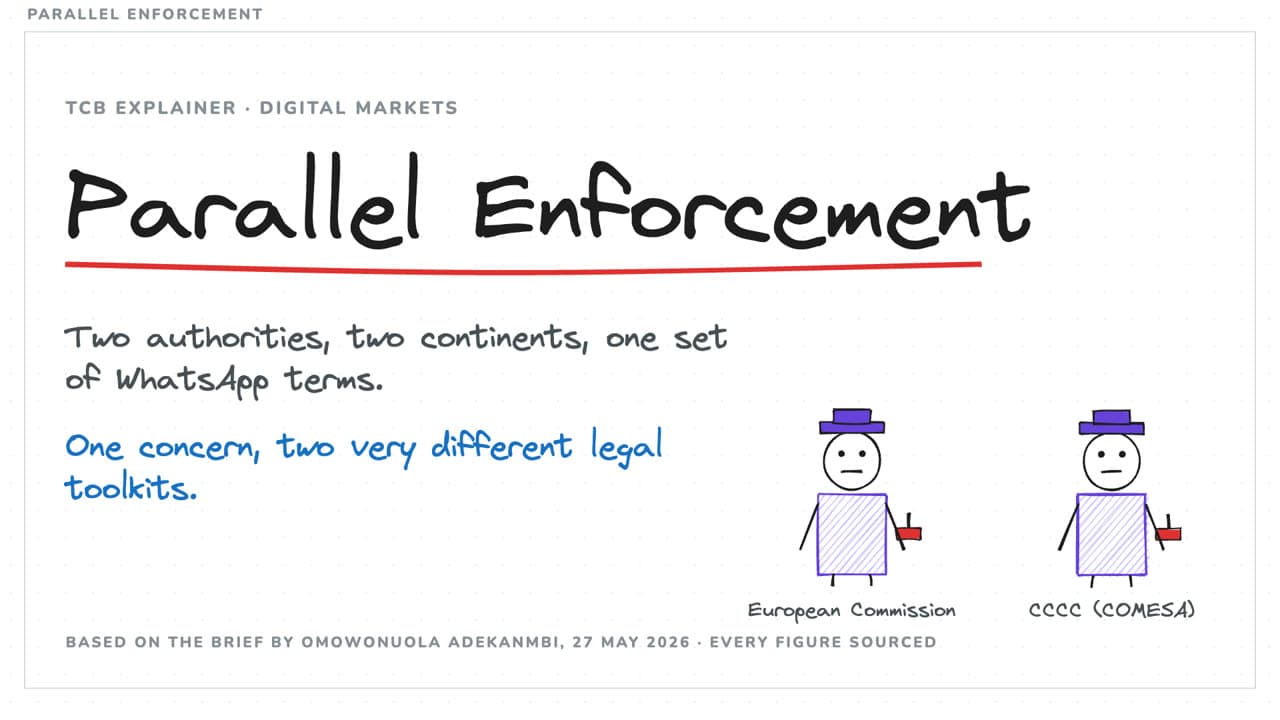
Parallel Enforcement at the Digital Gateway, explained
Meta faces abuse of dominance investigations in both the EU and COMESA over 2025 changes to its WhatsApp Business terms, which shut third-party AI providers out of the platform's API while sparing Meta's own AI. This explainer compares the two cases: why Brussels chose Article 102 over the Digital Markets Act, what makes COMESA's case a first, and where the two legal regimes diverge.
In this explainer
- 1
In October 2025 Meta barred developers whose main product is general-purpose AI from the WhatsApp Business API, while its own AI was exempt.
- 2
On 9 February 2026 the European Commission sent Meta a Statement of Objections under Article 102 TFEU: a preliminary view, not a finding. It used Article 102 because WhatsApp Business is not a designated core platform service under the DMA.
- 3
The COMESA Competition and Consumer Commission opened its investigation in February 2026, the first abuse of dominance case under COMESA's 2025 Regulations.
- 4
The regimes differ on dominance and remedies: EU law presumes dominance at 50% market share while COMESA relies on qualitative factors and also has an economic-dependence rule; both cap fines at 10% of turnover, but COMESA's applies only within the common market.
- 5
The brief argues the case marks a shift to parallel enforcement with African regulators as active participants, and calls for EU–COMESA coordination and a possible future role for the AfCFTA Competition Protocol.
Sources
- European Commission, press release IP/26/310 (9 February 2026)
- European Commission, press release IP/26/805 (April 2026)
- CCCC, Notice of Commencement of Investigation, Meta Platforms Ireland Limited (17 February 2026)
- COMESA Competition and Consumer Protection Regulations 2025
- WhatsApp Business Solution Terms
- Full reference list: 40 sources in the brief